
Implementation of the NHS England Lung Cancer Screening Programme over 5 years
Nature Medicine (2026)
Abstract
Lung cancer screening with low-dose computed tomography has been proven to reduce lung-cancer-specific and all-cause mortality. The UK launched the NHS England Targeted Lung Health Check Programme in 2019, which has now become the national Lung Cancer Screening Programme, with full coverage expected by 2030. Here we present the progress and outcomes of the program. People aged 55–74 were offered low-dose computed tomography of the thorax if they had ever smoked and if risk thresholds, as determined by multivariable models, were met. Delivery of the program is through regionally federated clinical infrastructure and leadership, with national strategic, clinical and economic frameworks. The program has invited over two million people, with 7,193 lung cancers diagnosed—63.1% at tumor, node, metastasis stage 1 and 12.6% stage 2—to March 2025. This has increased the early-stage proportion of lung cancer in England over 5 years, particularly in socioeconomically deprived regions. The NHS England Programme exemplifies how large-scale implementation can be achieved at speed through centralized protocols and effective project management. The program has demonstrated feasibility and scalability in reaching high-risk and underserved populations, but needs to further address inequalities in participation. These findings support adoption of lung cancer screening across the UK and globally, and offer practical tools for international adaptation.
Main
Lung cancer screening with low-dose computed tomography (LDCT) of the thorax has been shown by several randomized controlled trials to reduce lung-cancer-specific and all-cause mortality1,2. Globally, national-level progress in lung cancer screening varies from continued research, through evaluation of the clinical and cost-effectiveness of small pilot projects to full-scale implementation of national screening programs. The National Health Service (NHS) England Lung Cancer Screening Programme, known in its earlier, large-scale pilot phase as the Targeted Lung Health Check (TLHC) Programme, was launched in 2019, with the aim to improve the proportion of cancer detected at an early stage in England. NHS England had recently set a target of 75% of people with any cancer being diagnosed at stage 1 and 2 by 2028. The pilot was also expected to provide real-world evidence ahead of a revised evaluation by the UK National Screening Committee. The goal was to create a national strategic, clinical and economic framework, within which to achieve full-scale deployment. The pilot constituted an important contribution to the national early cancer diagnosis agenda, while identifying challenges and solutions to clinical referral pathways for lung cancer and other clinically relevant findings. This would also inform commissioning budgets for a full rollout. The program adheres to a detailed national protocol3 and quality assurance standard4, through regionally federated clinical infrastructure and leadership.
The progress toward implementation began with the UK Lung Screen pilot randomized trial5, which showed that lung cancer screening was feasible and able to achieve both a higher lung cancer detection rate and higher early-stage lung cancer proportion than the US National Lung Screening Trial, the first trial to confirm a mortality reduction6. Small nonrandomized pilot programs demonstrated similar results and, notably, very low levels of harm7,8,9,10,11. A large-scale pilot, the TLHC was approved by NHS England in 2019. In September 2022, lung cancer screening for high-risk individuals aged 55–74 years was formally recommended by the UK National Screening Committee after a detailed health economics evaluation12. The English government announced this in June 2023, with an acknowledgment that the annual cost would be £270 M per year at full rollout. On 1 February 2025, the TLHC was formally renamed as the NHS England Lung Cancer Screening Programme.
This Article reports on the progress and outcomes of the screening program to date, including the process of phased rollout, participant uptake, lung cancer detection and downstream management.
Results
Table 1 summarizes the total number of invitations, lung health checks, baseline LDCTs and lung cancers diagnosed for both the whole program and initial phase. Whole-program data represent total activity in the program until March 2025 with over 4.5 times the number of LDCT and lung cancer diagnoses than the initial phase data.
Whole-program lung screening performance metrics
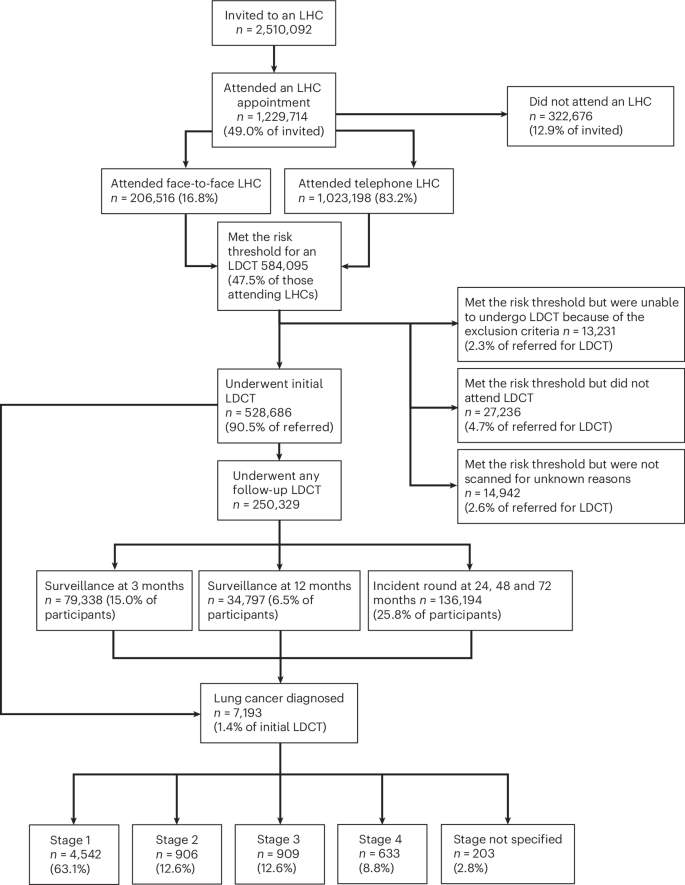
In the whole-program data from April 2019 to March 2025, 2,510,092 participants had been invited for a baseline Lung Health Check (LHC) across all Cancer Alliances (Fig. 1, consort diagram). This amounts to an invitation (coverage) of 32.4% of the total estimated, potentially eligible population of people who have ever smoked, aged 55–74 (7,743,437). Of those invited, 49.0% (1,229,714) have undergone an LHC (uptake of offer), and of these 16.8% (206,516 of 1,229,714) were performed face to face, and 83.2% (1,023,198) were performed by telephone, followed by face-to-face confirmation for those participants who qualified for LDCT screening; 47.5% (584,095) of participants met the multivariable model risk threshold (Liverpool Lung Projectv2 (LLPv2) or Prostate Lung Colorectal Ovarym2012 (PLCOm2012) models) and 43.0% (528,686 of 1,229,714 LHCs) underwent a baseline LDCT, while 4.7% (27,236 of 584,095 who met the LHC risk threshold and qualified for LDCT) did not attend or canceled their LDCT and 2.3% (13,231 of 584,095) met the risk threshold but were ineligible for LDCT on the basis of the exclusion criteria. A total of 2.6% (14,942 of 584,095) had no record of having had a scan, with reason unknown. A total of 79,338 three-month surveillance scans were performed, 34,797 twelve-month scans and there were 136,194 scans undertaken at 24, 48 and 72 months. The latter includes participants in whom incident round scans would not have been performed by the time of data extraction, that is a participant may have had a baseline scan but not yet have reached the point of having a 24-month scan. Therefore, the number of surveillance and incident round scans may be underrepresented. Extended Data Figs. 1 and 2summarize the program geography and proportional national rollout as a marker of coverage, according to Cancer Alliance. Figure 2a shows monthly (noncumulative) numbers of invites, LHCs completed and LDCT performed. Early efforts to initiate the program that were hindered by COVID-19 restrictions are notable until Spring 202113.
Whole-program data to March 2025.

a, Lung cancer screening delivery trajectories. The number of first invites (people invited), LHCs and scans (across every scanning round) per month for the whole program, from May 2019 to March 2025, are shown. b, National lung cancer early diagnosis rates. Early diagnosis rates (% diagnosed at tumour node metastasis (TMN) stages 1 and 2), as a proportion of all lung cancer diagnoses, have increased for all deprivation quintiles after the pandemic, with the biggest change in stage (low to high rate) seen among those living in the most deprived areas. Source: NHS England Analysis of Rapid Registration Data.
By March 2025, 7,193 lung cancers had been diagnosed (1.4% of baseline LDCT participants), 2,228 in the last year. The stage distribution was 63.1% stage 1, 12.6%, 12.6% and 8.8 % stage 2, 3 and 4, respectively, with 2.8% stage not specified (Fig. 1). National Cancer Registration Data (NCRD) show that lung cancer early stage detection rates across the UK have increased steadily since the pandemic and are now well above pre-pandemic levels. Furthermore, since the lung screening program started, the proportion of stages 1 and 2 lung cancers in the most deprived socioeconomic quintile has increased from the lowest to the highest quintile (Fig. 2b). This has not been reported in other cancers.
Initial-phase participant record-level demographic analysis
Of 582,700 people in the initial phase who were eligible for an LHC, 216,985 (37.2%) attended. The proportion of different groups of the eligible population, participation rates, LDCT attendance and cancer diagnoses are presented in Extended Data Table 1 , while the odds ratios (ORs) are presented in Fig. 3; 303,825 of 582,700 (52%) of the eligible population were male, and 275,335 of 582,700 (48%) were female. LHC uptake in men and women as a proportion of the eligible male and female populations, respectively, were equivalent (113,670 of 303,825 (37.4%) versus 103,310 of 275,335 (37.5%)), but fewer women underwent an LDCT scan as a proportion of those attending an LHC (48.4% females versus 56.7% males). Specifically, of those assessed as high risk, women were also less likely to attend an LDCT than men (OR = 0.87, P < 0.001).
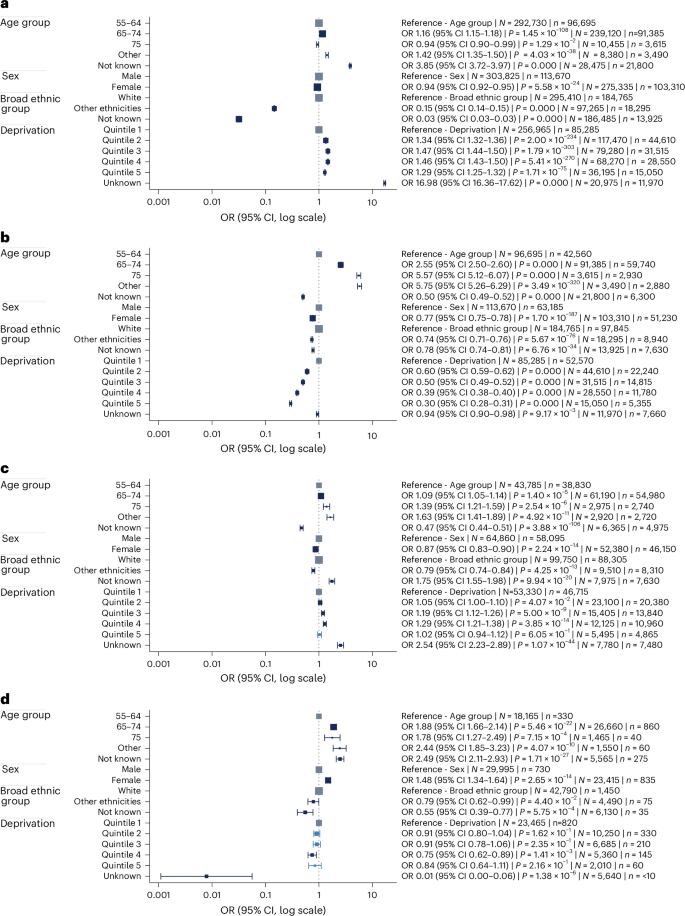
OR plots of initial-phase data assessing the associations between demographic characteristics. a, LHC attendance, of those in the eligible population. b, Participants assessed as high risk. c, LDCT attendance of those attending an LHC and high risk. d, Lung cancers detected of those who attended LDCT with ≥185-day follow-up. ORs represent point estimates and the accompanying error bars show the 95% confidence interval (CI). The size of each square is proportional to N, meaning that larger squares correspond to a greater number of individuals included at the start of the regression. Estimates were obtained using multivariable logistic regression. P values were calculated using two-sided Wald tests based on the standard normal distribution, with no adjustment for multiple comparisons. N refers to the total number of individuals included at the start of the regression (for example, people in the eligible population) and n refers to the number who experienced the outcome of interest (for example, those who attended an LHC). Counts were rounded to the nearest multiple of five and values below ten were suppressed to protect confidentiality.
Among those assessed as high risk, older individuals were more likely to undergo LDCT compared to the reference group aged 55–64 years (65–74 years, OR = 1.09, P < 0.001; 75+ years, OR = 1.39, P < 0.001).
Ethnicity data were not known for 32.6% of the 582,700 individuals eligible for an LHC because of incomplete primary care records. The further a participant progressed through the pathway, the more likely ethnicity status would be recorded. A smaller proportion of participants invited for an LHC in the ‘other’ ethnic group attended than those of the ‘white’ ethnic group (18,295 of 97,265, 18.8% versus 184,765 of 295,410, 62.5%; OR = 0.15, 95% CI = 0.14-0.15, P < 0.001). In the subset of people assessed as high risk at LHC, those from ethnic groups other than white were significantly less likely to attend LDCT compared to those from the white group (OR = 0.79, P < 0.001).
People in areas of least deprivation (quintile 5) had a higher LHC uptake than the most deprived (quintile 1) (15,050 of 36,195, 41.6% versus 85,285 of 256,965, 33.2%, OR = 1.29, 95% CI = 1.25–1.32, P < 0.001). However, 37.6% (5,665 of 15,050) of LHC participants from the least deprived areas underwent LDCT scanning versus 57.2% (48,760 of 85,285) people from quintile 1. After a high-risk assessment, those living in the most deprived quintile (quintile 1) were less likely to attend LDCT than those in quintiles 2 (OR = 1.05, P < 0.05), 3 (OR = 1.19, P < 0.001) and 4 (OR = 1.29, P < 0.001), but not significantly different to quintile 5 (OR = 1.02, P = 0.6).
Lung cancer detection in the initial phase
By January 2023, 74,202 participants had undertaken a baseline LDCT (Table 2). Three-month and 12-month nodule surveillance LDCTs were completed in 9,995 (13.5%) and 6,689 (9.0%), respectively. Three-month and 12-month scan data are not mutually exclusive (nodule assessment often requires both time points) and scans were censored at March 2024. Cancers (censored at August 2023) diagnosed from the baseline, 3-month and 12-month time point scans were 890, 135 and 70 (74.4%, 11.3% 5.9%) of 1,196 cancers diagnosed in the initial-phase data at all time points. This equates to a cumulative cancer conversion rate of 1.2%, 1.4%, and 1.5%, respectively of 74,202 participants. Twenty-four-month scans (most would represent incident round scans, and a minority of nodule surveillance scans) were documented in 24,933 participants of whom 36 were diagnosed with cancer (3.0% of 1,196 screen-detected cancers across both rounds); 2,393 scans at ‘other’ (undefined) time points detected 65 cancers. The total cancer detection proportion was 1.6% across both rounds.
Initial-phase data restricted to a follow-up period of at least 185 days from LDCT were available for 53,430 people; 2.9% (1,565 of 53,430) of participants had a lung cancer diagnosis in the Cancer Outcomes and Services Data (COSD)-linked data within 185 days of LDCT. Cancer outcomes were censored in August 2023, representing 185 days after LDCT (including those for nodule surveillance). The objective of this was to ensure that all cancer diagnoses resulted from the LDCT. This time was chosen after an analysis confirming that this did not include cancers diagnosed that were not related to the program. This approach was only for the initial-phase data. In this subset, cancers diagnosed were significantly higher in women than men (835 of 23,415, 3.6% in women, 730 of 29,995, 2.4% in men; OR = 1.48, 95% CI = 1.34–1.64, P < 0.001). Older (for example, 65–74 years) participants were also more likely to have a cancer diagnosis than younger (55–64 years) participants (OR = 1.88 CI = 1.66–2.14, P < 0.001) (Fig. 3 and Extended Data Table 1).
Incidental findings
Assessment of non-lung-cancer LDCT scan findings was made in 114,430 participants selected from the initial phase who underwent baseline LDCT scanning (Table 3); 54,695 (47.8%) had documented coronary artery calcification (severity grading was not collected), 36,745 (32.1%) had aortic valve calcification and 13,830 (12.1%) had emphysema (radiologically moderate or severe). Of note, 525 (0.46%) other (non-lung) cancers were diagnosed.
Discussion
The NHS England Lung Cancer Screening Programme (formerly TLHC) is a large, publicly funded national lung screening program that has scaled up at a fast pace by adopting a federated delivery model using a single mandated protocol and quality assurance standard. Both the delivery model and the program data provide a rich resource of real-world evidence for similar large-scale national programs that are at the stage of implementation. The scale of the program, with almost one-third of England’s total estimated eligible population having received invitations, demonstrates that implementation at scale is feasible. The whole-program results imply that the protocol is working, with 1.4% of participants diagnosed with lung cancer, of which 76% were at stages 1 and 2. Although the proportion of participants with lung cancer is lower than that observed in the British pilots, which was an average of 2% at the baseline round, it is in keeping with, or above, the proportion seen in the large randomized trials1,5,8,9,10,11,14.
The program has already shown an impact on the early-stage proportion in national lung cancer registry data, which has risen as screen-detected lung cancer has risen. No similar trend has been seen in other cancers in England. This demonstrates the impact that can be expected and was highlighted in an independent review of the NHS in England in 202415. The latest UK National Lung Cancer Audit reports increases in lung cancer incidence, stage 1 rates and surgical resection rates16. While data currently only show an increase in stages 1 and 2, the similar stage distribution to randomized trials showing a reduction in mortality suggests that a mortality reduction can be expected.
Most (83.2%) LHCs were delivered by telephone, an innovation adapted into the Standard Protocol in response to the COVID-19 pandemic, when it was found to be feasible and efficient. Although following the Standard Protocol and structural quality assurance standard is mandated, innovations can be proposed for review by the national operations team and clinical advisory committee. This flexibility is important to facilitate iterative improvements identified by the separate sites, while maintaining uniformity, which is felt to be a strength of the program.
The uptake of the offer for an LHC, 49.0% overall, is lower than in other screening programs but screening was initially targeted in the areas of highest socioeconomic deprivation, where uptake is lower in all screening programs. Our analysis of the initial-phase data confirmed that participants in the most deprived socioeconomic group and in non-white communities were less likely to respond to the invite. However, uptake is improving as the program progresses, with the latest data indicating over 60% (Fig. 2), comparing very favorably to other international experience in lung cancer screening. This may reflect the strong public engagement and careful steps taken to ensure that effective invitation methods were followed based on evidence from lung cancer and other screening programs17. Despite these encouraging findings, there should be concern about the people who choose not to respond. Even if it is assumed that the same proportion would be eligible for screening, this means that half of the population do not currently have the chance to benefit. As socioeconomic disadvantage is associated both with lower participation and lung cancer, it could be that an even greater proportion of those who benefit are being missed. In-service evaluation of changes to the program are important. An example is the recent change to the name of the program from ‘targeted lung health check’ to ‘lung cancer screening’. Before this, NHS England undertook a behavioral science-led assessment of a number of new names for both the program and the assessment. Surprisingly, participants preferred lung cancer screening for the program name because it was less ambiguous than ‘targeted lung health check’ but preferred ‘lung health check’ for the risk assessment by telephone or face to face. Further patient experience data are available from NHS England18.
The Lung Cancer Screening Programme is one of few to use multivariable risk models to define eligibility. This approach was chosen based on evidence showing that risk models are more efficient at identifying participants with lung cancer. More recent research confirms this finding19,20,21. The lung cancer detection proportion of 1.4% seen in this program is lower than that observed in the UK Lung Screening trial (~2%) and UK pilots, and may reflect the wider coverage of the population. Furthermore, the proportion was calculated using the prevalent round CT number as the denominator, which may overestimate compared with the pilots. However, at this point, most lung cancers were detected at baseline or during surveillance CTs. Nevertheless, the cancer proportion exceeds that reported from the USA, even before eligibility criteria were expanded further in the USA22. The decision to use two rather than a single risk model was made in view of the lack of prospective head-to-head comparison between these two models in terms of cancer yield and cost-effectiveness in the UK population at the time the program commenced. Whole-program data showed that of those attending an LHC 47% were assessed as high risk and 90.5% of those underwent LDCT.
The participant-level analysis in the ‘initial-phase’ data (Extended Data Table 1 and Fig. 3) showed that slightly fewer females attended an LHC overall, and fewer were assessed as high risk. This merits further analysis to establish whether this is simply explained by fewer high-risk women responding to an LHC, as seen in some trials23, or failure of risk prediction models to correctly predict risk. In addition, there was a slightly lower chance of undergoing LDCT in females who were assessed as high risk. LHC uptake was significantly lower in the more deprived, although these participants were more likely to be both at high risk and to have screen-detected cancer. The latter is expected and probably explained by the higher rates of smoking that would increase the risk estimates from both multivariable models. People from white ethnic backgrounds were markedly more likely to attend their LHC than people with other ethnicities (62.5% versus 18.8%). These data should be interpreted with caution because they represent participants in the earlier wave of invitations and consequently may differ from whole-program aggregated data where overall participation is higher. However, screening uptake is recognized to be affected by ethnicity in other screening programs24, and the marked difference for ethnicity demands close monitoring and should inform elements of future LHC design addressing inequities25,26. Additional gains in uptake and cancer detection may then be possible by delivering engagement strategies targeted at these underserved groups. Projects have trialed a wide range of approaches, with mixed results, but there has been insufficient assessment of efficacy, making this a topic for future research.
The increase in early-stage proportion shown by national lung cancer registration data in line with screening activity and the finding that this was most marked in the most deprived socioeconomic quintile of the population shows what countries can expect from lung cancer screening. The change in socioeconomic distribution of early-stage disease may reduce as the program is rolled out to areas with lower incidence of lung cancer, but the targeted nature of the program and the use of multivariable models should mitigate this by identifying those at higher risk who will inevitably be more likely to come from the more deprived sectors of society.
Early stage detection is subject to overdiagnosis; what is needed to confirm efficacy, is a reduction in late-stage rate and mortality. Both of these take longer to become apparent. However, a report from Manchester, one of the earliest sites, confirmed a 25% difference in late stage between geographical areas with and without screening27, which is correlated with mortality reduction28.
An important challenge has been the management of non-lung-cancer diagnoses and other incidental findings. From the outset, this was supported by an incidental findings protocol as part of the quality assurance standard4. The principle underlying the protocol is to act only on those findings where there is likely to be benefit. For example, the most common finding, coronary artery calcification, is managed assuming that most people eligible for screening will also be eligible for primary prevention. Many patients have not had this; therefore, the findings of moderate and severe calcification prompt a reminder to the participant and primary care team. Currently no additional action is recommended for mild calcification because the evidence for benefit in the context of screening is not confirmed29.
The program has quantified how common incidental findings are; while this provides opportunities to improve outcomes, management must also address overdiagnosis, physical and psychological harm, risk to program delivery and impact on workload in primary and secondary care. A study showed that despite a protocol being in place, many participants did not receive the recommended interventions30. In response, the latest version of the protocol includes nationally standardized pathways for the management of incidental findings. The incidental findings protocol is tailored to the UK healthcare system and, after legal opinion, addresses the medico-legal implications of the management of incidental findings. This was an important step in reassuring radiologists about the safety of following the protocol. It is an important country-specific aspect of management of incidental findings.
The screening program has put existing services under some pressure and required an increase in surgical and oncology capacity to manage the additional curative-intent treatment. As the program expands further, new sites are able to learn from earlier adopters about the requirement for expansion of services and workforce. The program has used locally outsourced capacity for LHC call provision and LDCT scanning, including mobile unit provision and radiology reporting. Computer-aided detection is already mandated for lung nodules and often includes automated volumetry. A future challenge is to ensure that lung screening meets the standards set for screening in the NHS, in particular robust quality assurance of performance. This in turn requires improved data systems bespoke to lung screening.
The main limitation of the analyses presented is that data collection is ‘real world’ and may not be as rigorously verified as in a research trial. However, the very large dataset presented mitigates this as there are unlikely to be systematic errors; any individual inaccuracies are unlikely to affect the overall analysis. Detailed participant record-level data with cancer diagnoses linked to national registration data were only available for the initial phases of the program, so this means that findings on demographic impact on screening participation are less reliable. For participant-level data, we censored dates for LDCT follow-up at 185 days for diagnoses related to screening, recorded through linked national registry data accepting that this may result in some underrepresentation of scan totals and attributable cancer diagnoses.
Missing data on ethnicity and problems with completeness of smoking records in primary care are an important challenge for successful implementation of lung cancer screening; this is often a greater challenge in other countries. Although NHS primary care records have relatively high levels of smoking record accuracy, for some individuals direct invitation to establish smoking status is required31.
Limited data were available for some important measures of performance. These include data on recall rate, incidental findings referral rate, details of nodule findings required to measure false positives, interval cancers and data on outcomes. This detail will be part of future publications, but some radiology reporting consortia collect these data and use this to feedback on individual radiology performance. NHS England has developed 14 effectiveness standards, currently in consultation, which are designed to provide a basis for performance management and quality assurance of outcomes.
The program does not currently have a bespoke, end-to-end participant-level information technology system, although this is recommended in the Standard Protocol3. This is expected in mid-2026.
The program presents an important opportunity for research and several studies have developed alongside the implementation, using datasets considerably larger than available from trials25,32.
In conclusion, the NHS England national Lung Cancer Screening Programme has shown how large-scale implementation can be achieved at speed in high-risk groups through the application of a single protocol and effective project management, informed by previous research and smaller-scale pilots. Almost a third of the eligible population has been invited, with evidence of downstream impacts on the stage of diagnosis in participants and national lung cancer data. In doing so it demonstrates what can be expected and provides practical tools adaptable for use in other countries. The program has achieved these results despite other significant challenges in the NHS, including workforce and economic strain, industrial action and a respiratory pandemic. These data, and the material available freely online, and as supplementary material, provide evidence of feasibility, of the impact of a larger-scale program and a blueprint to assist others implementing this essential element of lung cancer care.